Bears
Photographs, words and illustrations Nick Sidle
Widespread in the Northern Hemisphere and partly covering the Southern, bears are a successful and well adapted group of animals. Solitary creatures they are large and powerful and, something that should be remembered, fast on their feet most being capable of around 40 miles per hour.
In lore they are seen as animals very close to people, regarded as kin, ancestors or gods in disguise. In the North bears and people are often seen as interchangeable spirits and bears frequently appear as ancestors in some way, often a union between a person and a bear. They also appear as guardians of nature and divine messengers. Their own origin is sometimes referred to as being from amongst the stars including the constellation Ursa Major.
Asiatic Black Bear
The Asiatic Black Bear, Ursus thibetanus, is found throughout the forested hills and mountains of the continent from Afghanistan to Japan and is native to several countries and represented by seven subspecies. It is a large sized bear with adult males weighing 100-200kg, females 40-140kg. A very distinctive marking is a white or cream coloured crescent shape on the chest giving rise to the alternative name ‘Moon Bear’. They have a long snout, a white chin, ears large in proportion to their heads and thick neck hair almost forming a short mane. It is believed that this thick hair provides at least some protection from attacks by Tigers, which are in many places in the same areas as the bears.
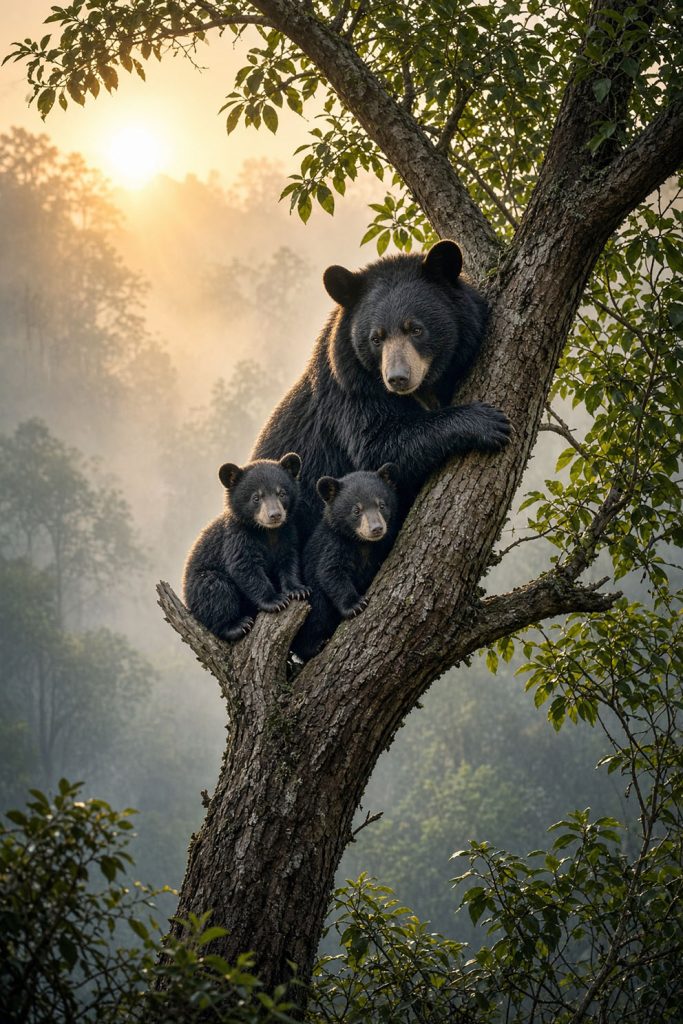
Indochinese Asiatic Black Bears, Ursus thibetanus mipinensis, Vietnam (digital illustration)
They are very much at home in the trees and can even build platforms to rest on by bending tree branches together. They are also regarded as potentially aggressive to people and are best treated with respect and understanding and left alone to themselves. Unfortunately, they are exploited for traditional medicines. The belief is that the bear’s bile will pass on its strength, fertility and stamina if taken, something which scientific medicine does not recognise. As a result, the bears have been hunted and kept in extremely inhumane conditions to be exploited in ‘bile farms’, operations which governments are now trying to close down.

Indochinese Asiatic Black Bears, Ursus thibetanus mipinensis, Vietnam (digital illustration)
The Asiatic Black Bear has an extensive folklore in many of the countries where it is found.
Vietnam
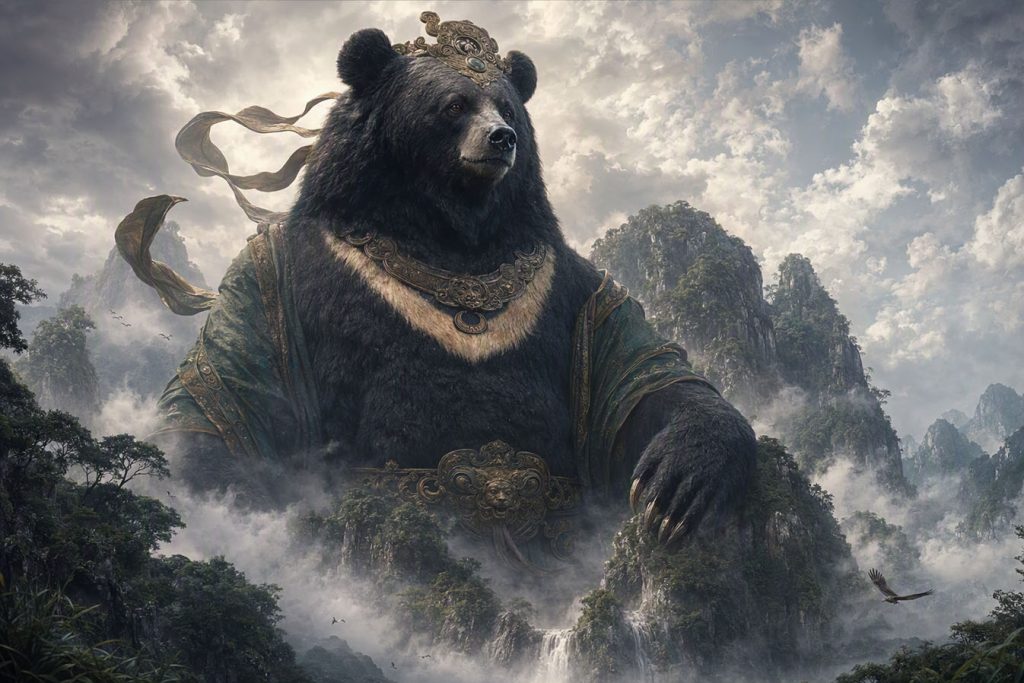
In Vietnam, the Asiatic Black Bear is also known as the horse bear because of its neck mane but it is as the Bear God Con Gáu that it truly enters the culture. Con Gáu has two main roles. One is as the husband of both the Sun Goddess, Mǎt GàTróng, who rides the sun rooster across the daylight sky and the moon
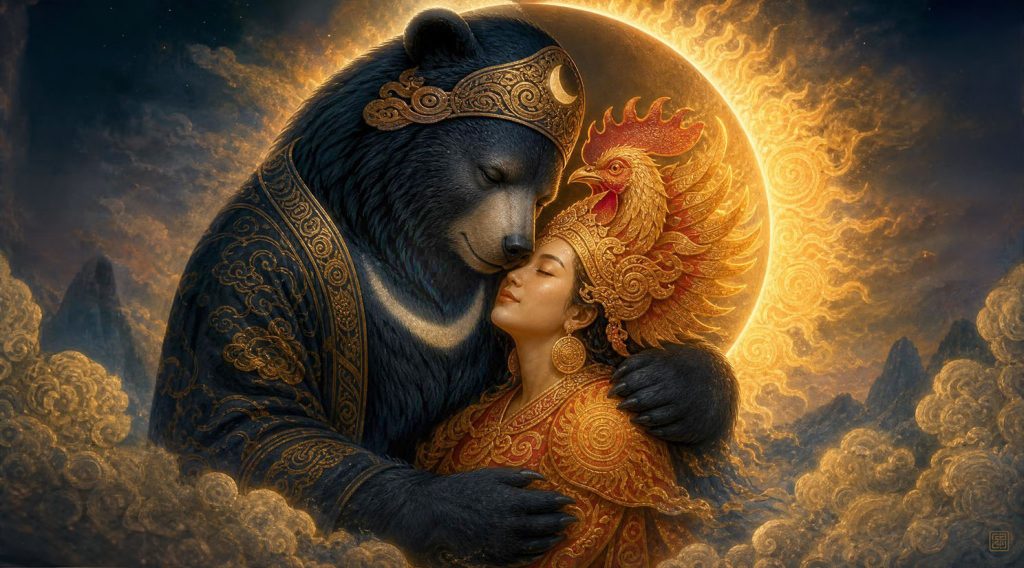
Digital illustration
Goddess, Trǎng Chim, who presides over the night from a cosmic swan. If Con Gáu, who was known to be truly passionate to his wives, visited them in the heavens and embraced them on too great a scale then there would be an eclipse, solar or lunar.
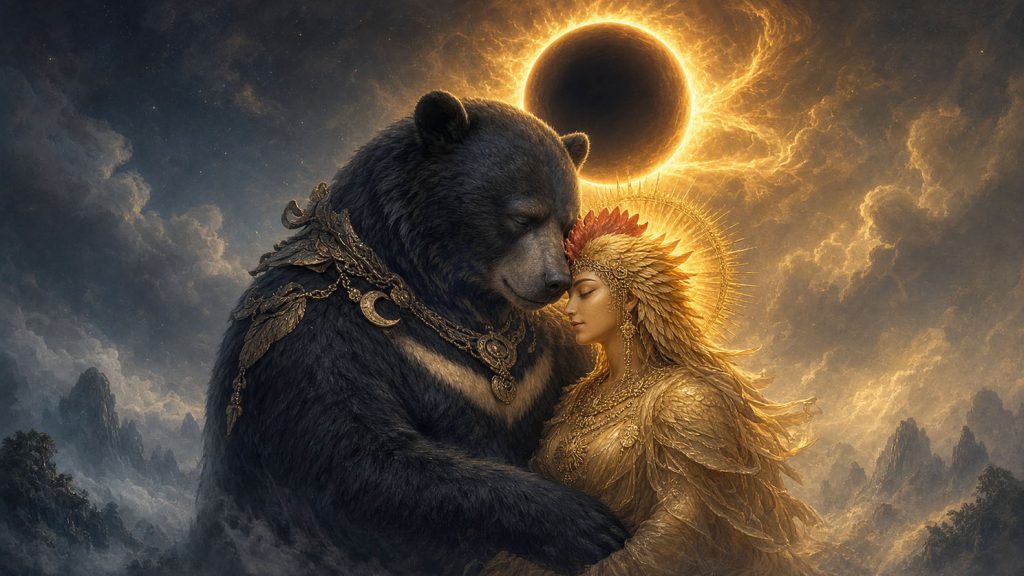
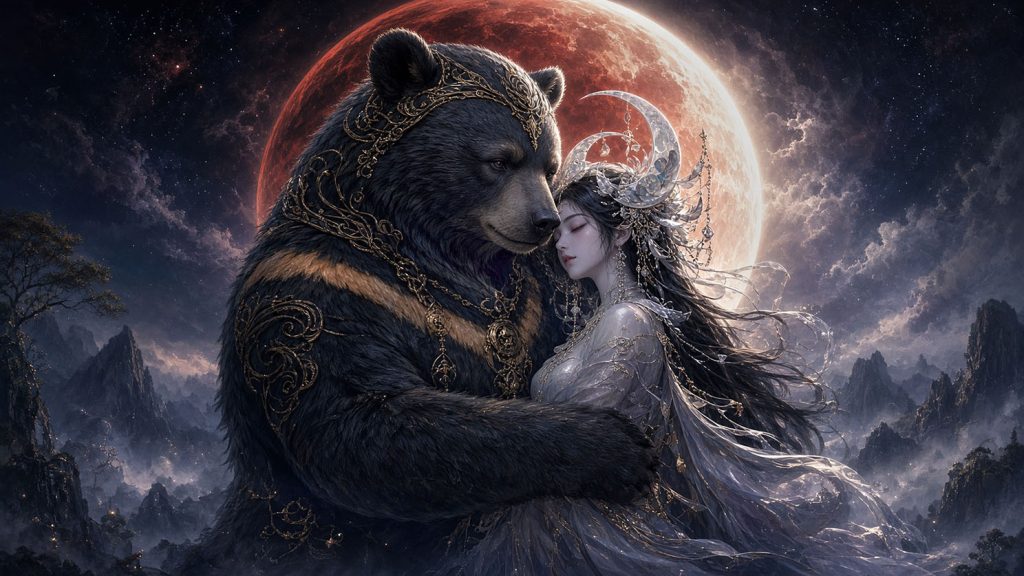
Digital illustrations
This would be because their embrace would block out the light and the fear was if the embrace went on too long, then the earth would be plunged into eternal darkness. To restore the light, villagers would go outside and beat gongs to disturb the bear, break the mood, and encourage him to return to earth.
Con Gáu’s other role is as the guardian of the mountains and the forest. In this role he is also a protector, guiding travellers and supervising the growth of medicinal plants and fruits in the jungle
Digital illustration
India and Hinduism
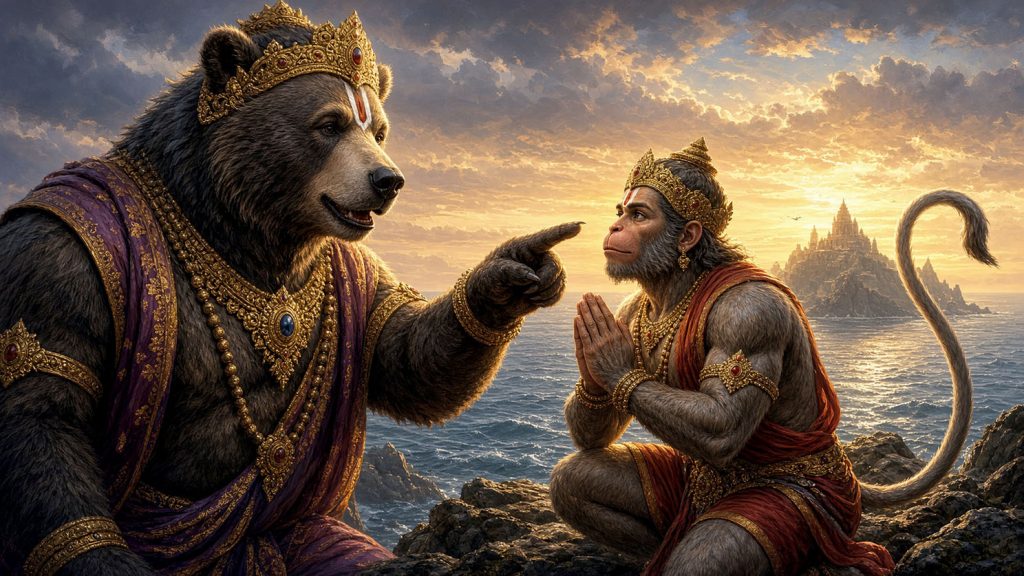
Jambavan (or Jambavantha), the divine king of the bears, is an immortal being whose path from his creation by Brahma weaves its way through Hindu scripture crossing multiple epochs and serving different incarnations of Vishnu. His most central moment is when he reminded Hanuman, the monkey God, of his divine powers freeing him from limitations and enabling him to make the leap over the ocean to Lanka and help rescue Sita, the wife of Rama as told in the Ramayana and central to the defeat of the demon Ravana, who Jambavan also fought himself knocking Ravana unconscious.
Digital illustration
Japan
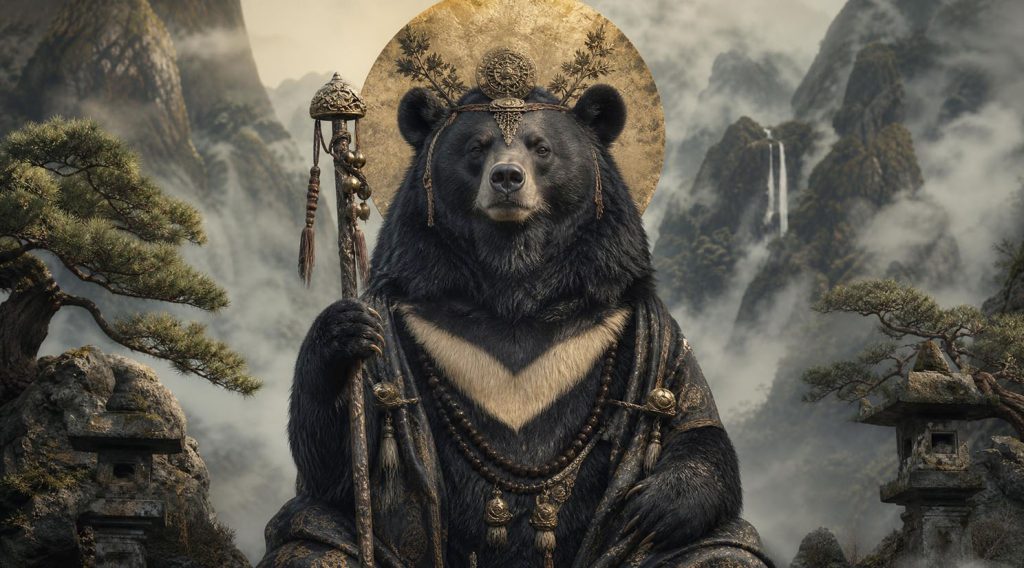
In Japan the Black Bear is closely associated with the Gods of the mountains, Yama-no-kami. The bears are both seen as the sacred messengers of the Gods or as a manifestation of a God. In mountain culture the Black Bears are particularly linked to the Shinto goddess Yama-no-kami, the spirit of the mountains and the bears themselves are thought of as a sacred extension of the mountain itself on which they are found. The significance is particularly strong for the Matagi, the winter hunters of Tōhoku region. More generally in the mountains bears can be personified as related figures ‘mountain man’ and ‘mountain uncle’. The white crescent on the bear’s chest is regarded in a story from Niigata as a mark left behind by a silk-wrapped amulet given to the Black Bears by Yama-no-kami herself.
Digital illustration
South Korea
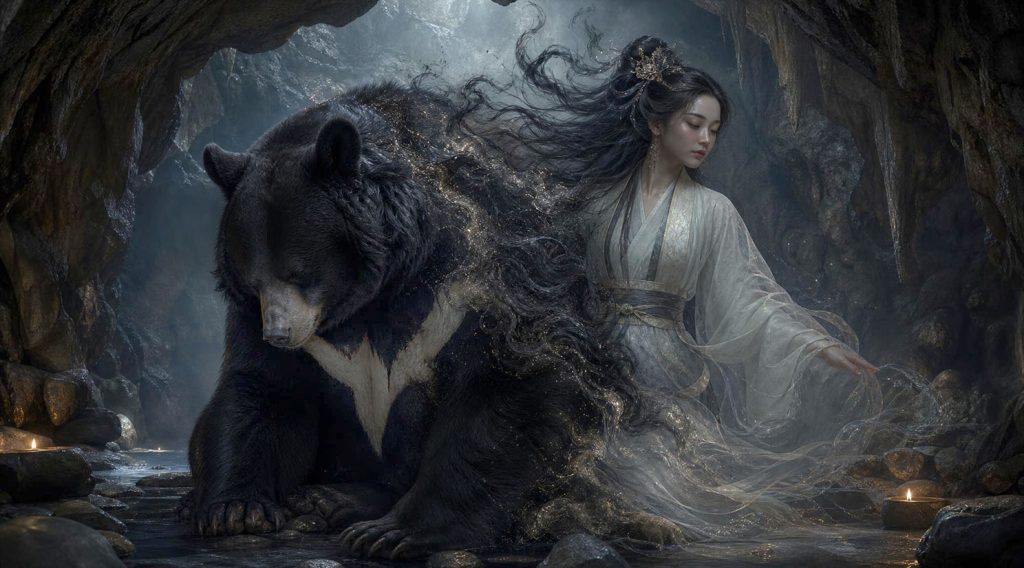
Black Bears are in some ways literally part of the foundations of this Korean nation’s history. According to the story of the birth of people, a bear and a tiger prayed to the divine prince Hwanung to become human. They were set a trial to retreat into a deep cave and survive on nothing but Mugwort and garlic for 100 days. The tiger gave up out of hunger but the bear completed the challenge and transformed into the first woman, Ungnyeo. She became lonely and again prayed for help and Hwanung temporarily assumed human form and married her. Their son Dangun became the founder of Korea and his mother the ancestral mother of all Korean people.
Digital illustration
Photographs, text and illustrations ©Nick Sidle, all rights reserved