Insights –
Insects and Arachnids
Photographs, illustrations and words Nick Sidle
Bee, Buff-tailed Bumblebee
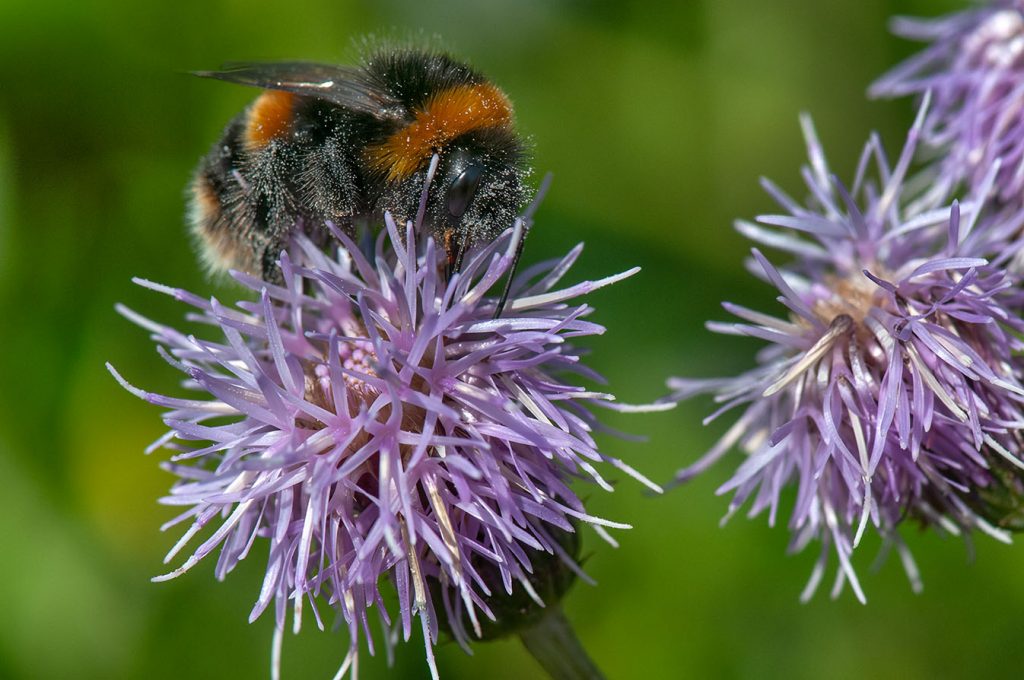
Buff-tailed Bumblebee, Bombus terrestris, Merkinch Local Nature Reserve (photograph)
One of the larger Bumblebees and, in recent years, increasing in its range North in Scotland which is attributed to rising average temperatures and the changing climate. Still seen flying later in Scotland than England.
Bees are essential to people through their role as pollinators. They are almost always a central part of any ecosystem they are found in so they are of enormous environmental significance in the natural world as well
Bee, Common Carder
The most numerous of the bumblebees and making a surface nest usually amongst dense vegetation, Common Carder Bees have pollen baskets on their hind legs to carry pollen back to the nest. There they build wax pockets at the base, which are filled with pollen as a food source for the larvae as they hatch.
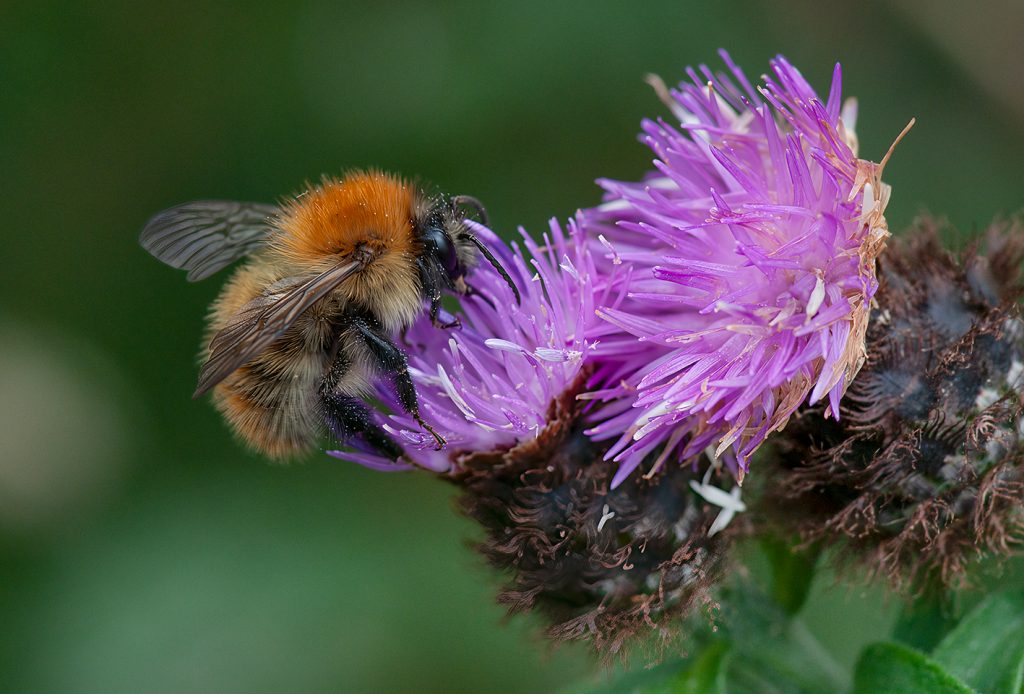
Common Carder Bee, Bombus pascuorum, Merkinch LNR Inverness, (photograph)
Customs in Scotland identify bees as essentially sacred and important parts of the natural world. Specific customs mostly centre on kept bee hives, which were regarded almost as part of the family, and Scotland shared the belief of ‘telling the bees’ with other parts of Europe in which it was a duty to go to a hive and literally tell the bees about important events, births, marriages, deaths, departures, arrivals affecting the household, their household. If this was not done, then the bees could desert the hive, stop producing honey or die. However, this is regarded today scientifically, modern mental health care would fully recognise the value of verbally telling the story of major life events, there may have been a very real supportive value in the tradition and whist the duty was to a family bee hive you cared for, a story could also be told to wild bees if you wanted to, they would be good listeners.
Bee, Great Yellow Bumblebee
Notable for its very variable colour, the Jewel Reed Beetle is named from the overlap between all the tints found and the striking colours used in jewellery through the ages. It has also been known as the Variable Reed Beetle for the same trait.

Great Yellow Bumblebee, Bombus distinguendus (digital illustration)
One of the rarest bumblebees in Britain, only found in the far North of Scotland, they used to be far more numerous and far more widely distributed. Seen on flower rich grasslands and in wildflower meadows they are active from mid May onwards through to September. The nests are smaller colonies than many bees and wasps having 50 to 80 worker bees, and are often found in abandoned vole, rat and mouse excavations or unused rabbit burrows. Basically, identified on their appearance of a yellow thorax with a black band and an essentially yellow abdomen, a further clue can be that they are said to have a deeper toned buzz than other bee species. They have a long tongue and feed on a wide variety of flowers although, they do appear to have favourites. The Great Yellow Bumblebee is frequently found on exposed sites so is comparatively unaffected by wind and weather but is usually found only on low ground, so may be relatively sensitive to cold temperatures.
Beetle, Jewel Reed
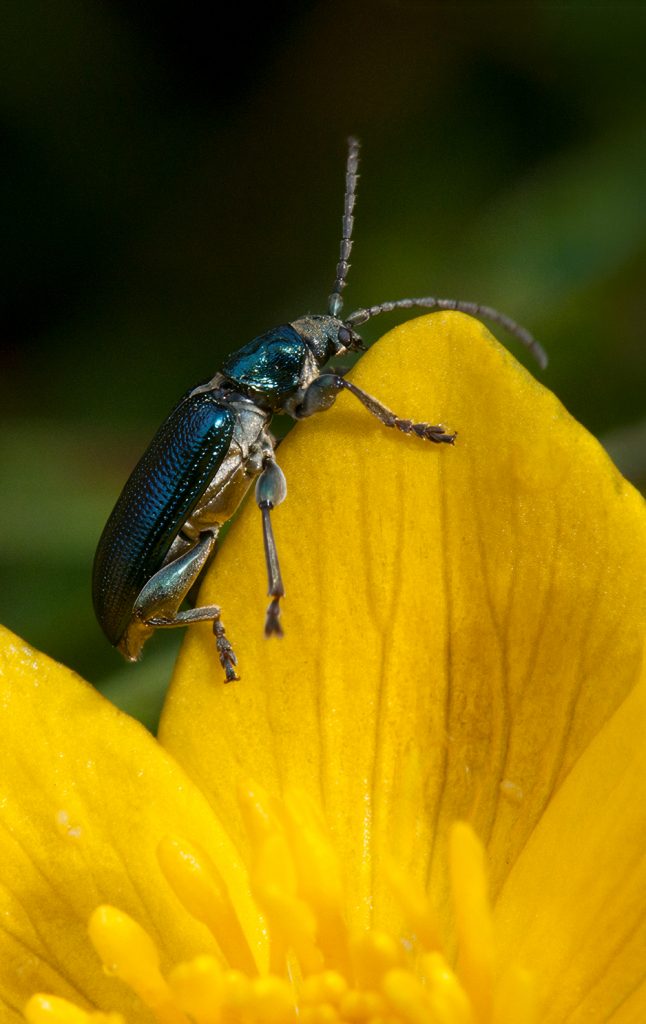
Jewel Reed Beetle, Plateumaris sericea, Merkinch Local Nature Reserve, Inverness (photograph)
Butterfly, Green-veined White
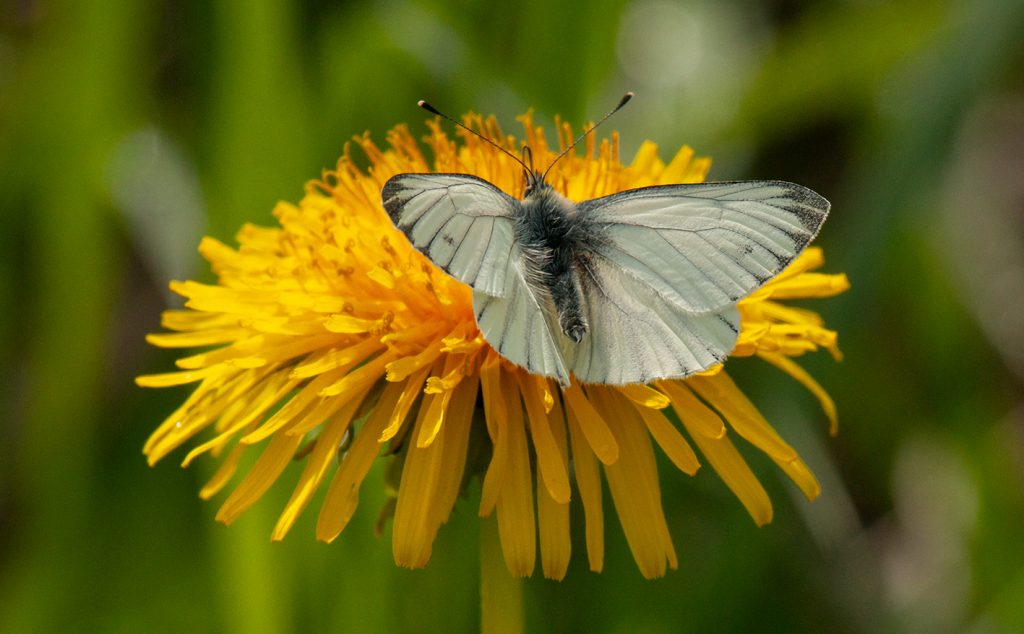
Green-veined White Butterfly, Pieris napi, Merkinch (photograph)
The Green-veined White is a common butterfly found throughout the British Isles except perhaps it isn’t. Sometimes referred to as the Green-veined White group, this is because it has been proposed that there are separate sub species, including a Scottish form. The differences, apart from tendencies in the appearance of the usual markings, come down to scent scales (androconial scales) on the wings, which are not visible to the naked eye, and whether the proposed sub species are separate for breeding, a requirement if they are to be recognised. The question has not been definitively answered. There is folklore stating that seeing a white butterfly early in summer means the season will be rainy. Green-veined Whites are a very resilient and successful species, but their numbers are hit by long dry summers. Exactly at what stage of the year this process begins is not clear, so it is even possible that higher numbers to be seen would be present early in a wetter year.
Butterfly, Painted Lady
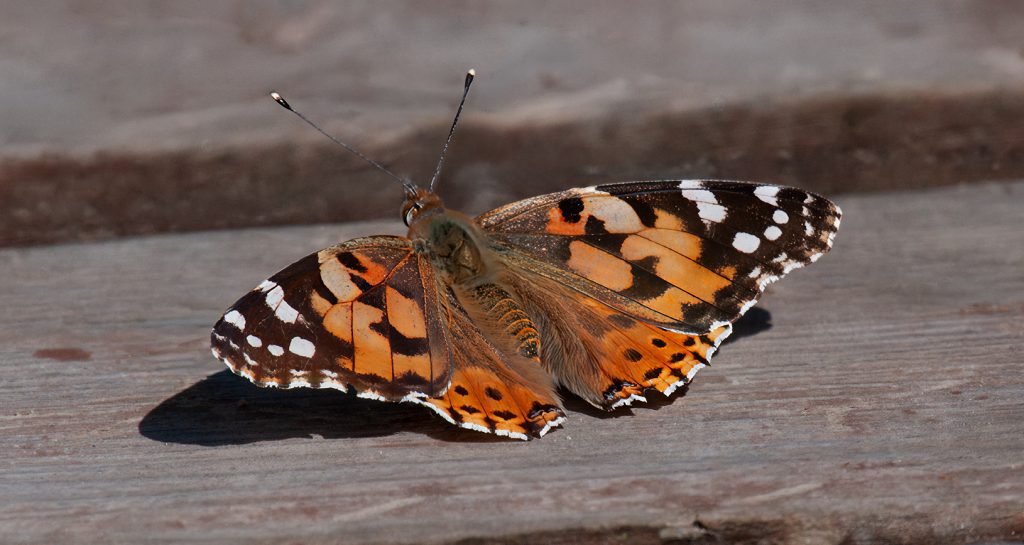
Painted lady, Vanessa cardui, Merkinch LNR, Inverness (photograph)
The painted lady is not a full time resident Scottish and UK species. It arrives here in the summer having migrated from Morocco, there is no real evidence for the Painted Lady successfully surviving a winter and it certainly does not do so in any significant numbers. The numbers arriving in the summer vary greatly with occasional exceptional years like 1996 seeing millions successfully make the journey and other years where total records can be very small with 1967 having only 100 recorded individuals. Once in Britain a warm summer can mean several generations but there are only a few records of a return migration South in the autumn. Recent research however has suggested that there is a very significant southerly movement but that the return occurs at high altitudes which is why it has not been noted before. This would mean a round trip journey of 9000 miles made over six consecutive generations of butterflies. When they do arrive they can be seen almost anywhere but are attracted to thistles which serve as the food plant for the caterpillars and are a source of nectar for the adults. Scotland has always been a known destination for the migration in the UK but sightings are less common than further South, especially the South coast of England where the butterflies arrive having crossed the channel. It is believed that orientation to the sun is the most important navigational tool for the Painted Lady. With this ability the Painted Lady has become the most widely distributed butterfly species on earth.
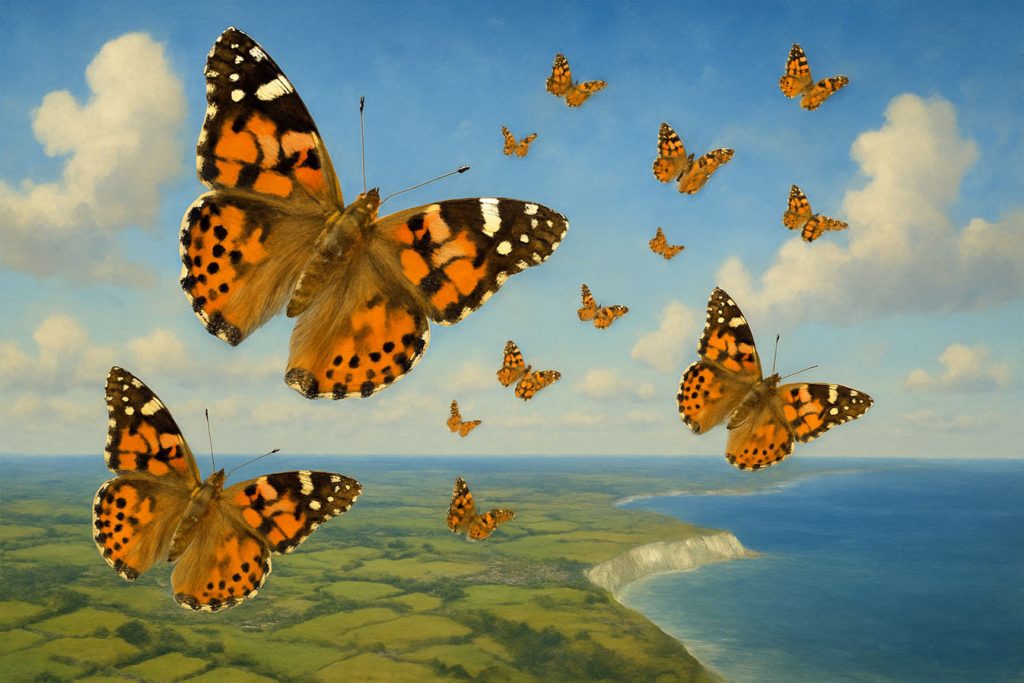
Painted Lady Butterflies, Vanessa cardui, migrating South over the South coast of England (digital illustration)
The name Painted Lady comes from the resemblance of its markings to some cosmetics especially historically with the use of rouge and white lead and black ‘beauty patches’. There was a short period in England when it was known as The Thistle Butterfly a name seen long term in the Netherlands and in Spain both themes emerge as it is called Bella Dama o Cardero, The Pretty Lady of the Thistles”.
Butterfly, Peacock
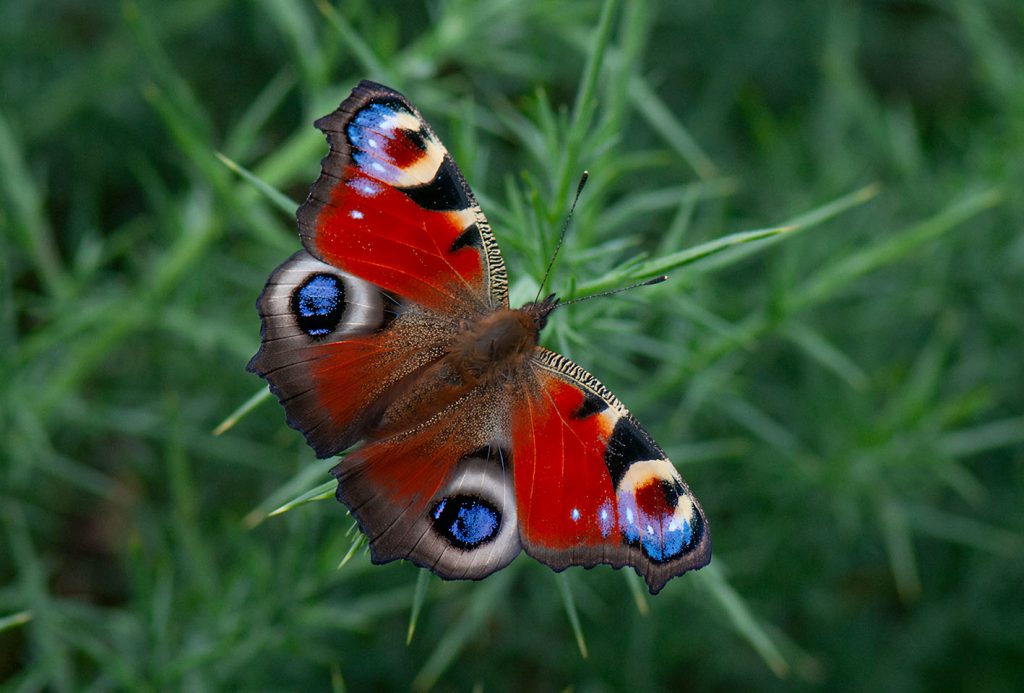
Peacock Butterfly, Inachis io, Merkinch LNR, Inverness (photograph)
Often simply referred to as ‘The Peacock’ the butterfly is a common resident species in England and Southern Scotland but less so in the North where it only migrates to in the early summer. Eastern Inverness-shire is around the limit of its Northern resident range. The caterpillars feed on Nettles. In the 1600’s and early 1700’s the butterfly was known as ‘The Peacock’s Eye’ from the wing markings. By around 1750 ‘eye’ had been dropped from the name to make it simply The Peacock.
Butterfly, Red Admiral
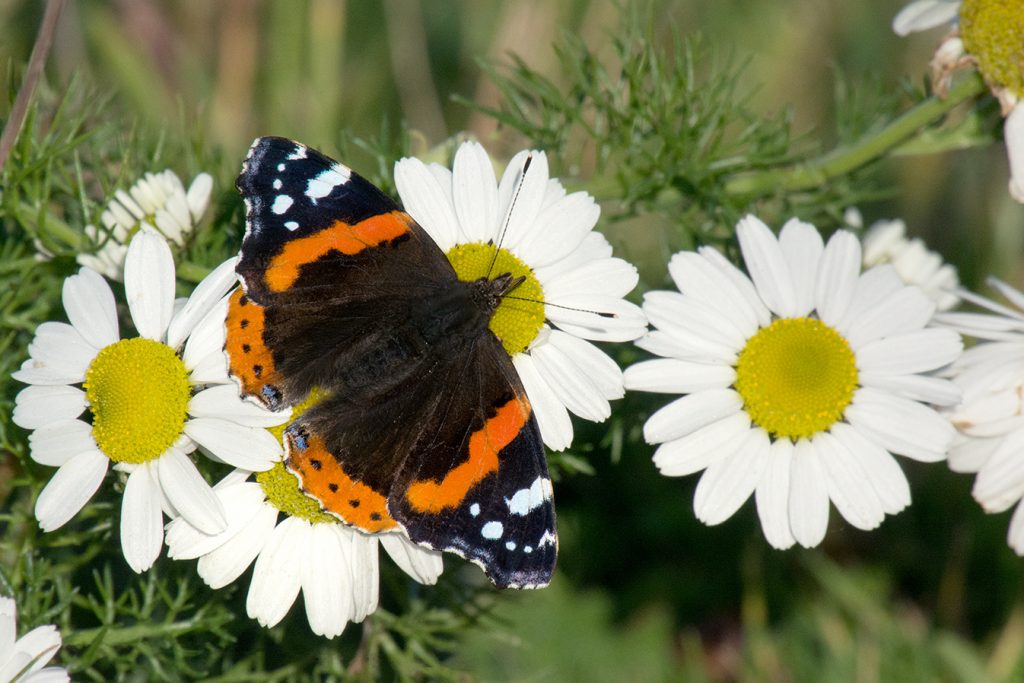
Red Admiral, Vanessa atalanta, Merkinch, November (photograph)
The Red Admiral Butterfly is essentially a summer visitor to the British Isles migrating from North Africa and Southern Europe each year. Typically, arrivals are from May and the return journey begins in September, in exceptional years these dates may be earlier or later, something that is being seen more often with changes in climate. Appearances of Red Admirals in moth traps set at night during the migration periods suggest that at least some of the journey is made in the dark. As average temperatures have risen, there is now a small resident UK population of Red Admirals that does not migrate but hibernates in the colder weeks.
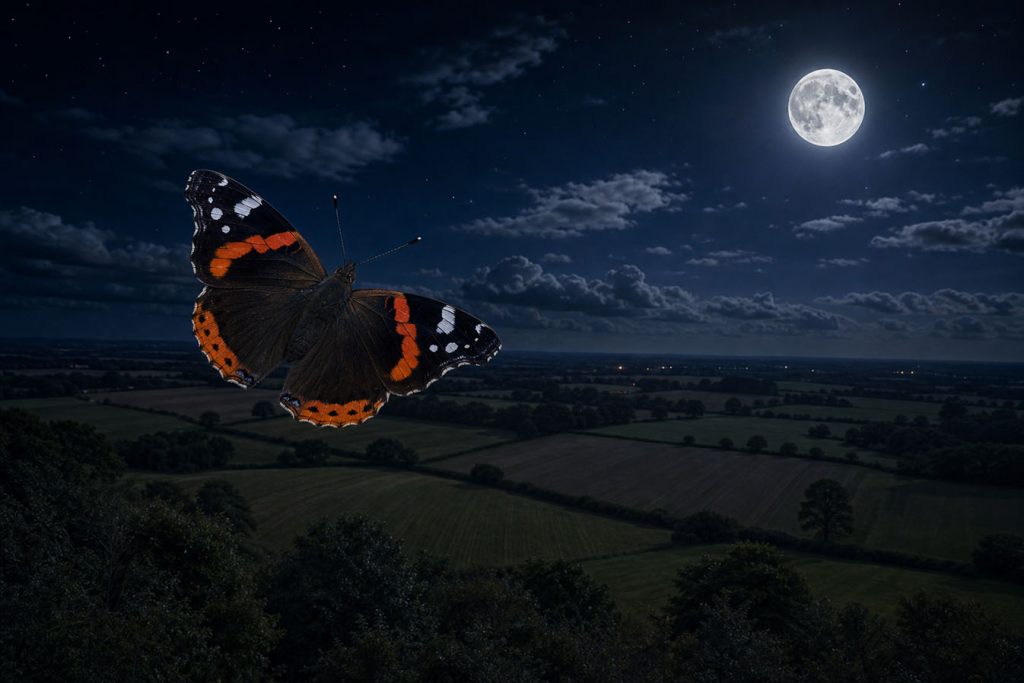
Red Admiral, Vanessa atalanta, migrating at night (digital illustration)
Then there is also the question of why a butterfly is called an admiral. There are various explanations linked to admiralty flags coming into use at the time the name was adopted, to a corruption of a name that began as the ‘Red Admirable’ but this does not seem very likely, to a corruption of ‘Red Alderman’ because their robes tend to have the same colours. It could have been more dramatic. In France, the butterfly is Le Vulcain linking it with Vulcan, who amongst the gods in mythology is connected with fire, volcanos, forges and metalwork.

Vulcan at his forge making weapons for the gods (digital illustration)
In art and beliefs, Christian cultural references in the past often make this butterfly a representation of sin and evil because of its colours and there was a time when the Red Admiral was hunted in North England and the Scottish Borders as a witch and, more widely in Scotland, was seen as a warning of malicious magic.
Butterfly, Speckled Wood
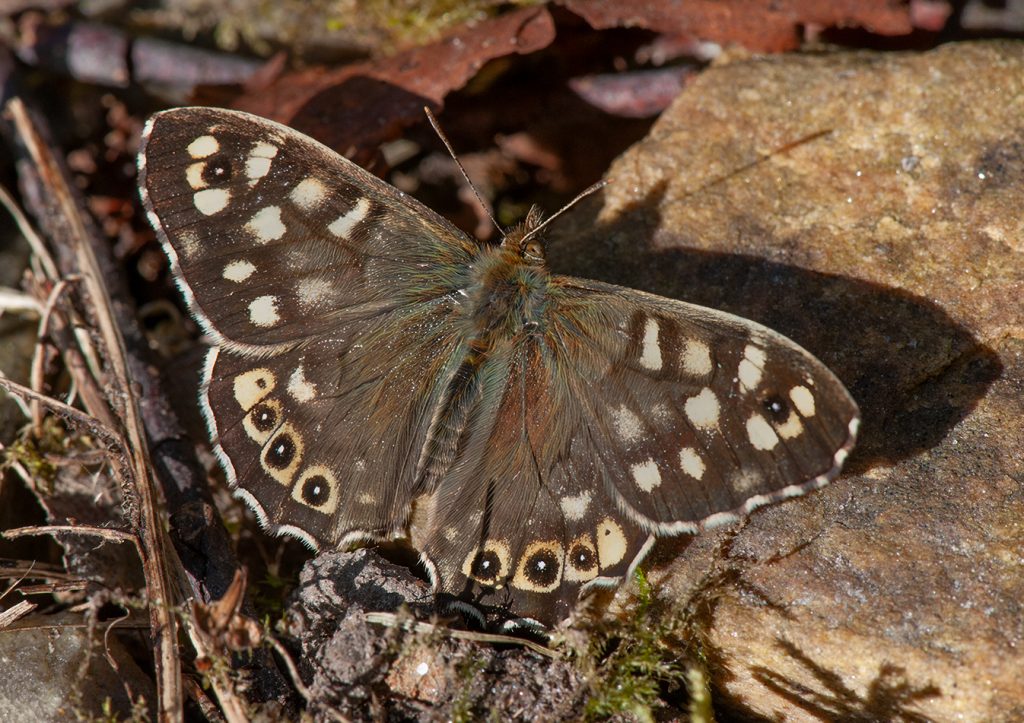
Speckled Wood Butterfly, Pararge aegeria, Merkinch Local Nature Reserve, Inverness (photograph)
A butterfly that has spread North in Britain very significantly in the last 100 years, it is represented in Scotland by what some regard as a separate sub species, the Scottish Speckled Wood. The males are fiercely territorial defending a patch of sunlight in woodland. They will try to drive off any intruder and not just other butterflies. They are also prepared to take on any animal, including birds which might actually put them at risk and, it is said, they will also try and drive off people who stray onto their patch. That this behaviour is rarely noticed might be because it is rare or might be it is rarely that they make any sort of impression on their target that is remembered.
Dragonfly, Southern Hawker

Southern Hawker Dragonfly, Aeshna cyanea, Glen Convinth, Inverness-shire, Highland Scotland (photograph)
A large dragonfly found around water and woodland glades just, not really till recently, in Scotland. In the last few years, they have moved much further North including the Highlands and that is because the climate is changing, they like it now it’s warmer. They are known for being inquisitive and will often come close to check you out. If you follow the Japanese view, this is good since dragonflies are seen as bringers of good fortune but in Europe, they are often thought of as aligned with darker forces or in Sweden as an omen of tragedy and seekers of bad souls, so if one hovers near you it is to weigh your soul in judgement. In Scotland, one Gaelic name is Tarbh-nathair-neimh, which translates as ‘venomous bull-serpent’ which is a bit harsh, they don’t sting, they have no venom and don’t look like a snake. We don’t have to worry about them and can see them as a new friend but why they are here now is a different question.
Moth, Alder

Alder Moth, Acronicta alni, Glen Convinth, Inverness-shire, Highland Scotland (photograph)
Not a Highland Scottish species but spreading slowly North with rising average temperatures. Seen on 17th June in Glen Convinth, confirmed as one of the very few sightings this far North.
Moth, Dark Bordered Beauty

Dark Bordered Beauty Moth, Epione vespertaria, Cairngorms National Park, Highland Scotland (photograph)
The Dark Bordered Beauty Moth, one of the rarest in Britain and at risk of extinction in Scotland and England. Insects have evolved over 480 million years, we never know what the loss of even one species will mean. Now found in a new site in Scotland thanks to a captive breeding programme.
Moth, Large Emerald

Large Emerald Moth, Geometra papilionaria, Glen Convinth, Highland Scotland (photograph)
Moth, Nettle-tap
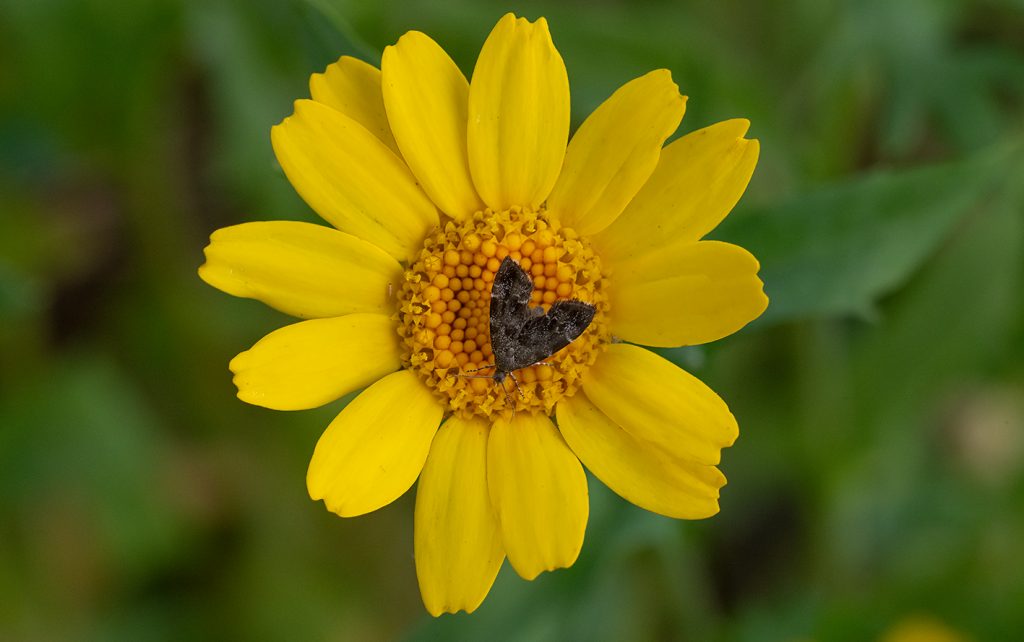
Nettle-tap Moth, Anthophila fabriciana, Merkinch, Inverness (photograph)
A small daylight flying moth found throughout Scotland and the UK. It is not just Britain or even Europe where the Nettle-tap is seen, the moth is found to the East as far as Japan including China, Afghanistan and Russia and in 2013, was recorded in Canada. The Nettle-tap has stinging nettles as its food plant for the larvae and adults are often seen around nettles during the day. it also comes to rest between flights on nearby flowers. The frequent, highly mobile flights and rapid movements when they first settle on a flower to feed have meant that some descriptions of the Nettle-tap place it in a category of ‘dancers’ amongst the moths and butterflies, giving rise to the ‘tap’ part of the name and making the nettle leaves and flowers its stage. The scientific name, Anthophila fabriciana, translates as ‘Fabricius’s Flower-lover.
Moth, Saxon

Saxon Moth, Hyppa rectilinear, Glen Convinth, Inverness-shire, Highland Scotland (photograph)
Now you don’t see me, now you don’t…..see me. Saxon Moth, Hyppa rectilinea. Scarce in the UK, more widespread in the Highlands. Master of camouflage.
Termite, Subterranean
Don Rowlands OAM and Dr Nick Sidle
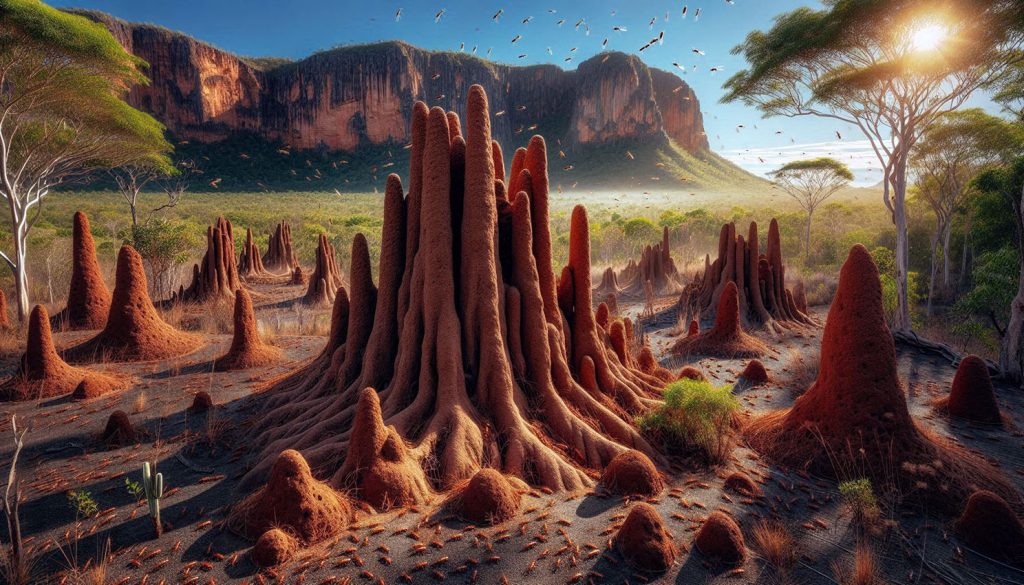
Termite Mound (digital illustration)
Termites are a very important part of an ecosystem, they break down dead wood and other organic matter releasing nutrients and recycling carbon and nitrogen, both essential for plant growth. Termites are known to particularly accelerate decomposition during droughts, partly offsetting the negative effect of water scarcity. By tunnelling in the soil, they distribute nutrients, water and produce aeration.
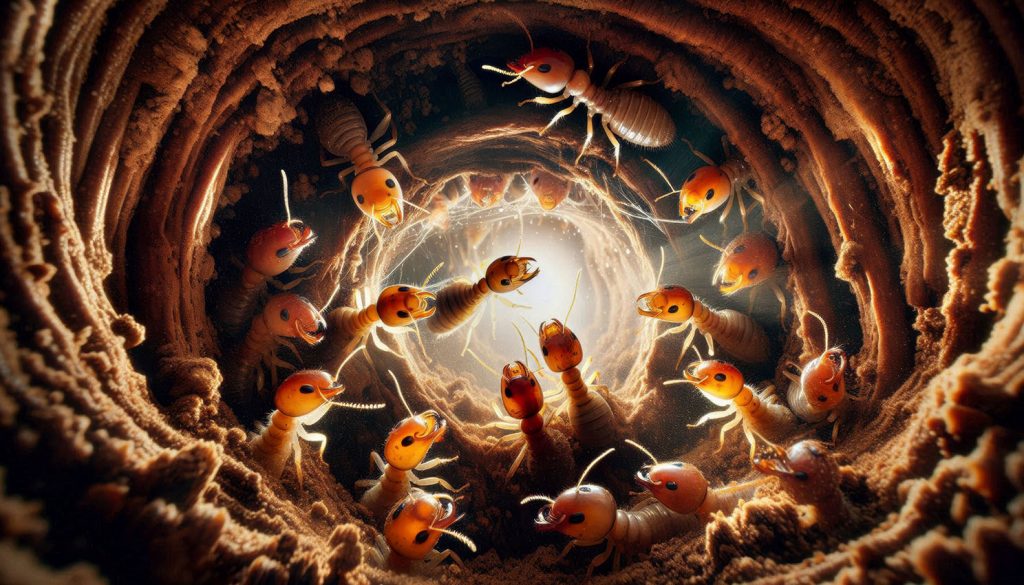
Subterranean Termites, Coptotermes acinaciformis (digital illustration)
Their mounds can be valuable habitats in their own right, benefitting the smallest microbes right up to reptiles and small mammals. They are now acknowledged to directly enhance plant growth and forest regeneration, they have even been confirmed in some cases as increasing crop yields.
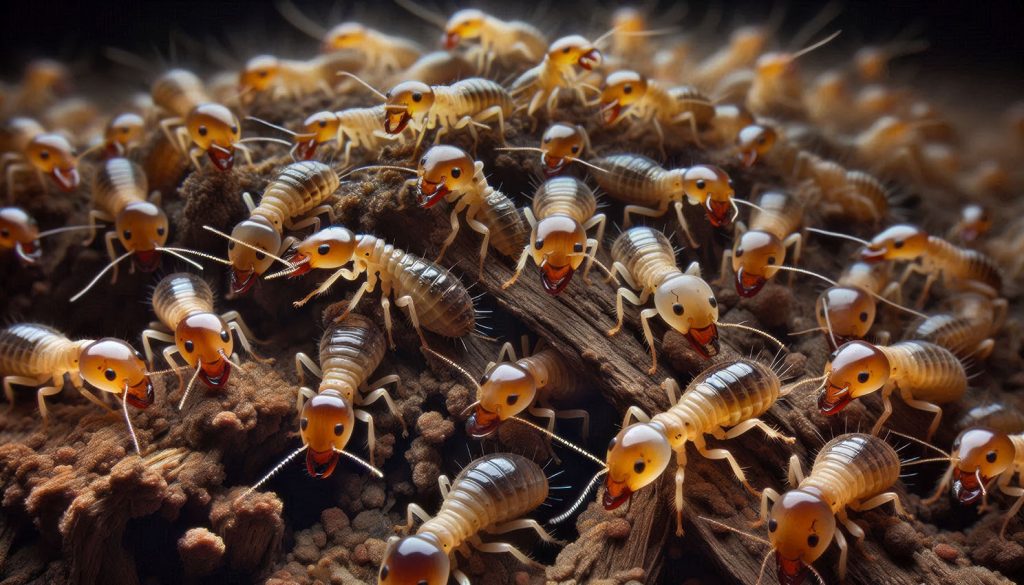
Subterranean Termites, Coptotermes acinaciformis (digital illustration)
Termites are a vital component in the functions and cycles of the natural world. If they were removed from it the effects would be devastating. Unfortunately, outside the natural world it is their presence that can be just as devastating. Wood in houses and buildings is, in a botanical sense, dead. The termites have evolved to deal with that, to them it is a job to do and a call to action, it needs to be broken down and fed back into growth. The damage can be enormous, they can also locally severely harm crops and agriculture. Only a small minority of species are true pests but they can bring very real destruction.
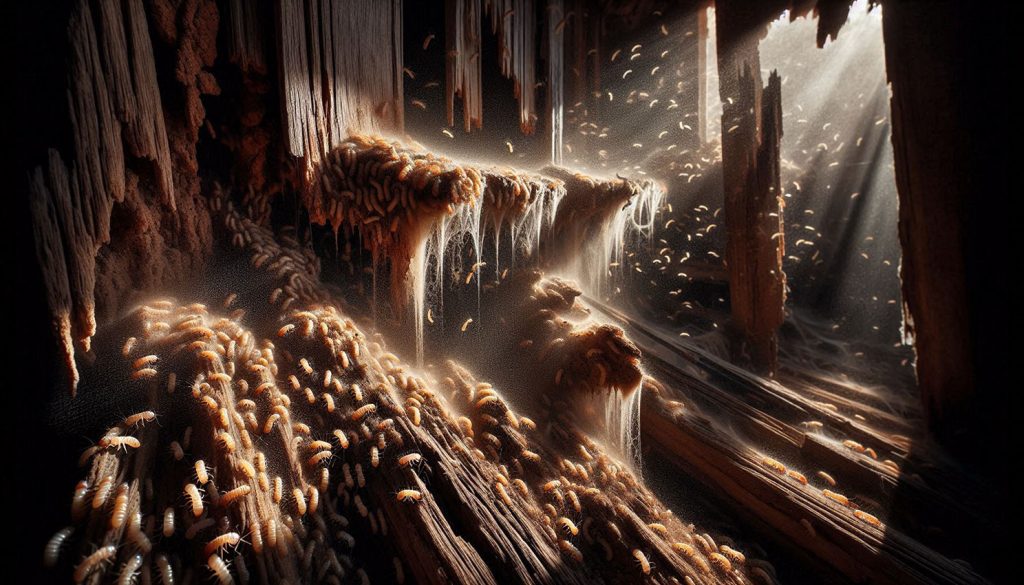
Termite damage to buildings (digital illustration)
To date, this has been an issue mostly in the tropics but with rising temperatures across the world, there are real questions about an increase in their range. New places will have to answer questions around termites in future years, and new places will need the ecological advantages they bring.
University of Michigan – Termites may have a larger role in future ecosystems
To balance the vital role of termites with protecting the things they can damage will depend on understanding and knowing them better. We need to look at the science that is already known, to push the boundaries of knowledge with new research but we also need to listen to older cultures that have seen Termites in their place and understood that they make a huge contribution to life. They are also quite good at life themselves. Normally, the lifespan of small insects is brutally short. Termite workers and soldiers live one to two years, a long time for an insect of their size but the lifespan of the queen is measured in decades, a typical queen lives for 25 to 50 years, 100 years has even been reported, the longest known life for any insect.
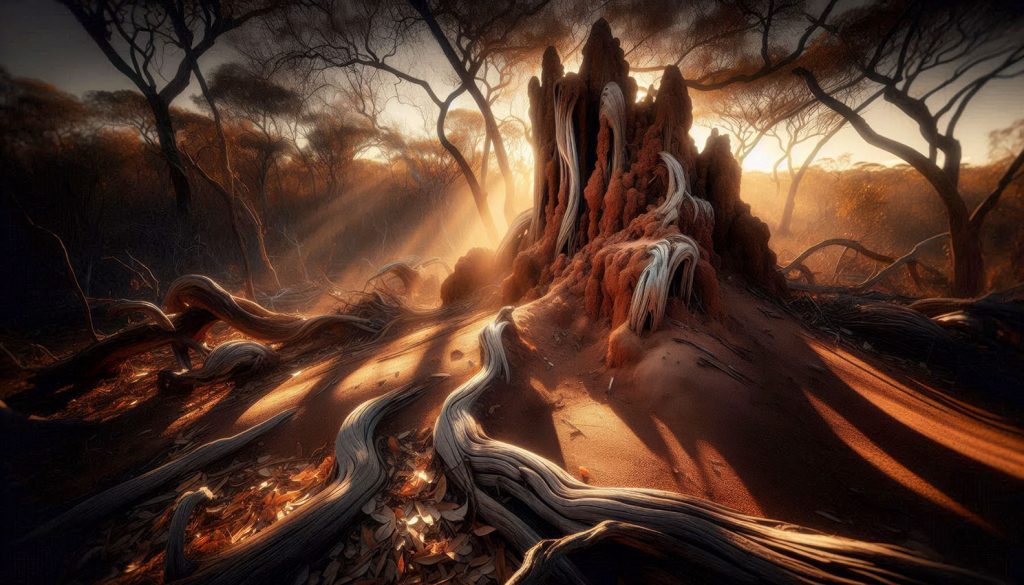
Termite Mound (digital illustration)
Text © The Authors, all rights reserved
Photographs, and illustrations ©Nick Sidle, all rights reserved